Tips
What makes AI agents reliable enough for real work
An AI agent becomes reliable through the setup around the model. Each one has one job, its own notes and written rules. Checks refuse bad work, and a person approves. Wednesday 18 November 2026 on video, with the letters our checks refused that day.
An AI agent is reliable enough for real work when the setup around the model is. The model writes the code and the mail. Everything else is what makes the result safe to use. Each agent has one job, its own folder and its own notes. Rules are written down once, checks refuse bad work, and a person approves what leaves.
None of that is clever. Most of it is the same discipline a careful team uses. Wednesday 18 November 2026 shows the parts working, and the video below is that day.
What the video shows
A room seen from above, with desks. Each character with a name tag is one of our AI agent sessions or a helper it started. At 07:54 two agents wait under an amber banner, one on a question and one on an approval. At 08:38 three of them stand at the person's desk. At 13:03 the banner is empty for the first time since 07:29. At 14:04 helpers fill the desks, with blue pills that show a command running. At 19:10, after dark, nine of twenty are working. One frame a minute, no sound.
- 0:00Wednesday 18 November 2026, 07:05.
- 0:03Each tag is an AI agent with one job, or a helper it started.
- 0:0707:54. One agent waits on a question, another on an approval.
- 0:1308:38. Three agents wait at the person's desk.
- 0:15Until a person answers, each one holds its job open.
- 0:1913:03. The banner is empty for the first time since 07:29.
- 0:2314:04. Helpers at the desks. A blue pill is a command running.
- 0:2619:10. After dark, nine of twenty at work, helpers included.
- 0:31Rules, checks and approvals decide what leaves the office.
What happened on Wednesday 18 November?
Every time below is Israel time. The recorder takes one frame a minute from 07:00, so frame N is 07:00 plus N minutes.
- 07:29. Our fax product’s agent asks a question. It stops and waits for the answer.
- 07:39. Our search agent asks for an approval.
- 08:19. The agent that runs our tennis data product asks a question too. At 08:38 all three stand at the person’s desk.
- 07:29 to 13:02. At least one agent is waiting for a person in every one of those minutes.
- 11:37 and 11:38. Three of the four open waits clear, and three agents at work become six.
- 13:00. The longest wait of the day reads 4 hours 41 minutes. At 13:03 the banner is empty for the first time since 07:29.
- 14:23. Twelve of twenty-two are working, helpers included, the most that day.
- 19:10. After dark, nine of twenty are working.
The counts come from a status strip under the room, which we cut out of the video because it also names our accounts. They include helpers, the short-lived copies an agent starts for part of a task.
What does each agent start with?
One job. Each session runs one thing: a product’s operations, the servers, the search work, sales outreach. A narrow job means a short list of things it can break.
Its own folder. A session works in its own directory. When two agents work on the same code, each gets its own copy of it, so one never edits under the other.
Notes it keeps. Sessions keep a memory folder of short notes: what they learned, what went wrong, what the person decided. They read the index at the start of the next session. The sessions we start from our home folder share one such folder, and it holds 145 notes today.
Rules written once. Standing rules live in a file the agent reads before it does anything. They say things like “never add an AI attribution line to a commit” and “never write to the file server as root”. A rule is written down the day it is learned, with the date and the reason.
The office shows some of an agent’s state on its own desk. This 18-second film reads one desk: the screen, the paper cups and the bin.
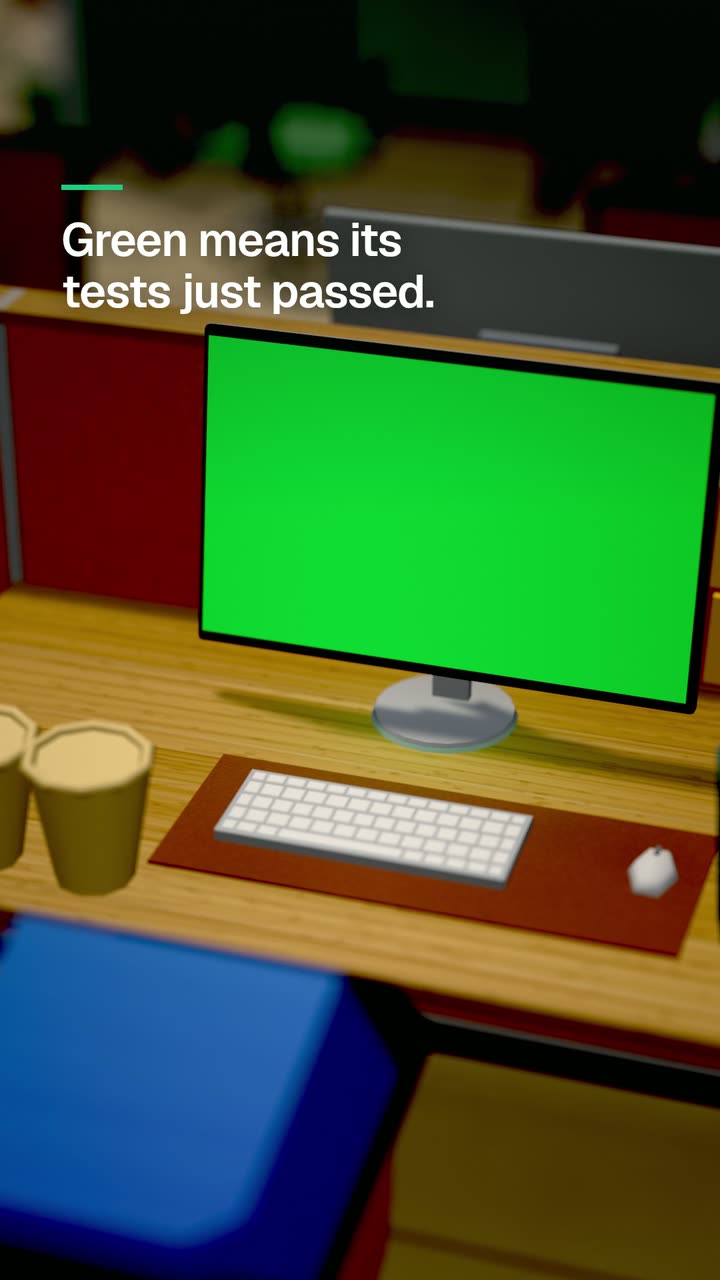
Film, 18 seconds
One desk, close up: the screen, the paper cups and the bin. The screen follows the work, and green means the agent's tests just passed. There is one paper cup for each half hour on a task. A full bin is a full memory.
The agent names, task names and site names on screen are a demo team, not our real work.
What stops a mistake before it leaves?
Rules in a file can be ignored. So the rules that matter most are also checks, which refuse.
On 18 November the send checks of our mail desks refused letters that agents had written at least six times. Three of them:
- 15:40. A reply gave a date that had been worked out, not looked up. The check wants every figure in a letter traced to a recorded fact, so it refused. That draft never went out.
- 16:03. A reply greeted someone by a first name that their address did not show. The check refused it, and the letter went out from the person’s own mailbox instead.
- 18:33. Another reply did the same. It went out with “Hello,” instead.
None of these was a disaster. Each was a small thing a careful person would catch, caught by a rule that never gets tired.
The same idea runs through the rest of the setup:
- Code reaches the main branch of this site only through a pull request, and only when the build check passes. That has been a rule of the repository since 3 October 2026.
- The build of this site runs twenty checks: links, structured data, page weight, the security policy, plain language and more. One failure stops the release.
- A hook reads every commit message and pull request text before it is sent, and refuses one that reads like a machine wrote it. Skipping it takes a written reason, which is logged.
- This video went through a privacy gate. It reads every word in every frame it uses and refuses any name tag nobody has cleared. A private project’s characters walked all over the room that day. So each shot is a stretch of minutes in which none of their name tags is inside the frame.
Who checks the checker?
A second agent, with no stake in the first one’s work. Before each post in this series goes out, an independent fact check compares every claim with the frames and the code. For our last post it found the video’s captions out of step with the picture by 6 seconds. We fixed the video before release.
An agent that wrote something is the worst judge of it, for the same reason a person is. The review has to come from somewhere else.
What still needs a person?
Decisions. Our agents ask before anything that costs money and before mail about money or terms. They ask about our social posts too, though for this series the person approved the style once. The amber banner in the video is that rule at work. Each line is an agent that stopped to ask.
That wait is the price of the setup. On Wednesday it was five and a half hours of open questions in the morning. We wrote about that cost in why we run on AI agents instead of hiring a team.
The agents also run on a server that stays on, which the first post of this series describes. So the work that starts when a question clears does not stop at the end of the day. At 19:10 nine of twenty were still busy.
What doesn’t this fix?
A check only catches the mistakes someone thought to write it for. A new kind of mistake gets through the first time. Then it becomes a rule, and the rules that matter most become checks.
The rules also need keeping up. A rule that was true in October can be wrong in November, and an agent will follow it anyway. Most notes carry a date, so a stale one is easy to find.
We build this kind of setup for other companies. One service covers agents that act in your tools, and another covers the internal workflows around them. If you have a job in mind, tell us about it.